

TFP_ Show Notes • Episode #003 • Gary Taubes • Part 2
The Pennington lecture, the method of multiple working hypotheses, and whether the carbohydrate-insulin model can survive being wrong.

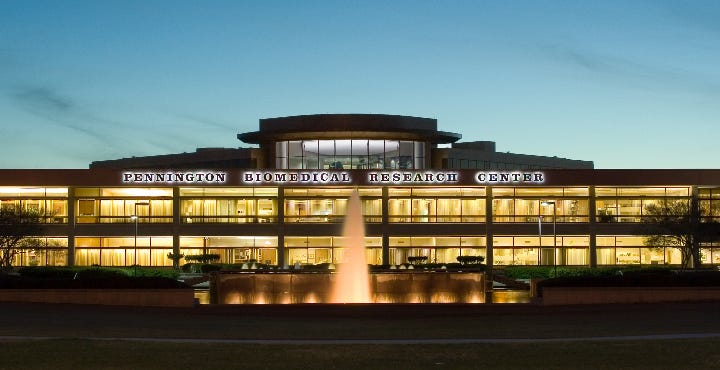
Part 2 picks up immediately where Part 1 left off — with Gary’s teaser question hanging in the air. The conversation deepens substantially from here: the full story of the Pennington lecture, the psychological and career cost of being told your life’s work was wrong, Gary’s genuine reckoning with the possibility that he himself could be wrong, the method of multiple working hypotheses as the gold standard for scientific practice, the fiber-and-carnivore blind spot, the GLP-1 mechanism debate, the full carbohydrate-insulin model including the sugar-as-fuse hypothesis, familial hypercholesterolemia classifications, and a closing exchange about what it means to be a software engineer from Vegas contributing to medical science.
The Pennington lecture: “Are we all idiots?” [0:00]
• The episode opens with the teaser from Part 1 playing out in full. The question Gary was asked at the Pennington Biomedical Research Institute in Baton Rouge — the leading academic obesity research institute in the United States — was this: “Mr. Taubes, is it fair to say that one subtext of your talk is that we are all idiots?”
• Gary’s answer, then and now: “Yeah, that’s fair. But I can’t say that.” He adds immediately: it was exactly the right question.
• The context: Gary was invited to give a lecture on the carbohydrate-insulin model to a standing-room-only audience of obesity researchers. He is very deliberate in how he structures these talks. The word “carbohydrate” doesn’t appear until 40 minutes in because the moment he mentions it, people start thinking Atkins quackery. He wants them to follow the logic of deconstructing energy balance and reconstructing a better hypothesis before the political associations kick in.
• At the Q&A, the faculty member who asks the question is, Gary notes, probably his age now — mid-60s, grey hair, visibly disturbed. He frames the question precisely because he has understood exactly what Gary’s argument implies about the field he has spent his career in.
• Gary’s actual answer to the room was gentler: I don’t think you’re idiots. When you entered the field in the 1960s, you inherited a paradigm that seemed so commonsensical you never questioned it. That paradigm was energy balance. You get fat because you eat too much. You grew up with it, it was never tested, and you never even realized there was an alternative hypothesis that explained the data better.
The unacceptable implication: careers, awards, and the cost of being wrong [10:40]
• The reason paradigm challenges are so hard to accept, Gary argues, is not stupidity or even laziness. It is the implication. If the alternative hypothesis is right, then: I spent my whole life promoting the wrong idea. I spent my whole career doing damage when I thought I was doing good. All the awards I’ve won, all the acclaim from my peers — it’s meaningless because I was wrong and they were wrong.
• He is emphatic: these are assumptions nobody can embrace. And yet they should never be framed that way. The right framing is: you were working with the information available at the time. You still deserve the awards for what was known then. The problem is not the work you did; the problem is the institutional culture that prevents course correction now that better information exists.
• Dave adds a version of this from engineering: the “junior in the room” phenomenon. You have four or five senior engineers deep in a complex architecture on a whiteboard. A junior engineer in the back quietly says something like “what if we just did this.” And it’s the most obviously correct idea in the room. None of the seniors saw it. The humility required to accept that is manageable when your whole career isn’t built on the alternative. In science, it often is.
• Gary sharpens the distinction: it wasn’t just that they missed the obvious. They didn’t do their job as scientists. When you inherit a hypothesis at the start of your career, you are supposed to look into the history of it. You are supposed to know where it came from, whether there were challenges to it, whether it was ever seriously tested. That is what scientists do. In the 1960s, this was still possible. They could have done what Gary did. They chose not to.
• He invokes Feynman’s 1974 Caltech commencement address: the first principle of science is you must not fool yourself, and you are the easiest person to fool. Part of Feynman’s point was that it was not enough to take someone’s work and try to improve on it. You first had to make sure the original work was right. Then you could build on it.
Gary’s own reckoning: what if he is wrong? [12:03]
• This section is unusually candid. Gary raises the possibility — directly and without prompting — that the low-carbohydrate and ketogenic diet movement could be wrong in ways that are not yet visible.
• His specific concern is cancer. He has two friends, allies in his world, young people, who have died of cancer. He has rationalized it. But it worries him. The history of medicine is littered with interventions that seemed to be working until, a decade later, the complications became apparent. He describes reading the history of type 1 diabetes management after insulin’s discovery in 1921: these children who seemed to be saved, living apparently healthy lives, and then after about a decade, their bodies starting to fail in every direction simultaneously. Blindness. Kidney failure. Neuropathy. Heart disease. A book called Bittersweet documents this.
• His honest statement: what you can tell people is that eating this way will make them healthier, feel healthier, improve most metabolic markers — except possibly LDL, which may not improve. But you cannot promise anything about long-term outcomes because the population has not been followed long enough. We don’t have that information.
• Dave responds that he himself has been on record multiple times saying exactly this — that lean mass hyperresponders may not show the association between ApoB, LDL, and plaque progression that the study is designed to test, but that something outside the current peripheral view — cancer, for instance — could still turn out to be an issue.
• Gary’s reply: that is the proper humility. Part of the reason scientists talk about humility as essential to the scientific method is because you are so likely to be wrong that you need to leave yourself an out so you can accept it when it happens. The question he asked at Pennington works in both directions.
Jay Bhattacharya, NIH reform, and the institutional problem of dissent during crises [19:47]
• Gary mentions he was listening to a Bari Weiss interview with Jay Bhattacharya — now director of NIH — on the drive over. He knows Jay and is a fan. He hopes Jay will use the position to drive meaningful nutrition research.
• He uses the COVID policy debate as a parallel to the obesity debate. Bhattacharya co-authored the Great Barrington Declaration challenging the lockdown consensus. What Fauci and Collins did in defending their position when challenged, Gary says, is psychologically understandable even if scientifically indefensible: you have an epidemic, people are dying, you feel you cannot afford to allow your actions to be questioned because then people will not follow your advice. So you cannot allow for dissent. And you simultaneously have to convince yourself that you did the right thing because hundreds of millions of lives depended on it.
• His point: they are never going to reach the conclusion that their decision was wrong and caused more harm than good. People just have trouble getting there. He adds, carefully, that he might have the same problem himself if the situation were reversed.
• Dave connects this back to the pattern from Part 1: the doubling down, the tripling down, the building of entire institutional systems to keep out what keeps coming at you to force a change. Gary says: this is what T.C. Chamberlain was writing about in 1890.
The method of multiple working hypotheses: T.C. Chamberlain, 1890 [22:31]
• One of Gary’s favorite papers in the history of science is from 1890: “The Method of Multiple Working Hypotheses” by geologist Thomas C. Chamberlain. Chamberlain was president of the American Association for the Advancement of Science and contributed significantly to the theory of continental drift.
• Chamberlain’s argument, distilled: there are several ways to do science. The first is the method of the dominant hypothesis — you fall in love with one idea and spend your career trying to prove it true. The second is competing hypotheses. But what he advocates for is multiple working hypotheses: generate as many possible explanations as you can for whatever you are observing, and test them simultaneously. Because as soon as you fall in love with one of them, that’s the end of productive work. Nothing positive comes from it unless by sheer luck you happened to pick the right one.
• Gary connects this to Francis Bacon in 1620, who said roughly the same thing when he developed the scientific method: our brains are wired to see evidence that supports our beliefs and to reject evidence that doesn’t. The entire scientific method was designed as a corrective to that human tendency — to make us give more credence to evidence that refutes our hypothesis than evidence that supports it.
• He tells Bacon’s shipwreck story: a man walks into a church trying to decide whether to believe in God. A priest shows him a painting of five people who survived a shipwreck. The priest says: they all believed in God and they survived. That’s proof. The man asks: what about everyone else on the ship who believed in God and drowned? That is the negative evidence. It is more powerful than the positive evidence. Science is about paying attention to the negative evidence.
• The paradox Gary identifies: to keep doing this work in the face of constant pushback, you need faith in your theory. But simultaneously, you have to assume you’re wrong. Not everyone is psychologically wired to hold both of those at the same time.
Dave’s research journey: from blog to publication, and the cost of treating manuscripts as stone [0:58]
• Dave reflects on the arc from CholesterolCode.com — where he was iterating in public, posting experiments, responding to comments, refining hypotheses in real time — to the formal publication process, which he finds frustrating in its slowness and in the institutional weight it places on each manuscript.
• His specific frustration: the blog felt like pure science to him. The hard work was in the design of the next experiment based on what the last one told him. The postmortem on what went wrong. The rapid iteration. Now there is an enormous amount of effort in situating each manuscript correctly before it is published, and he misses that speed.
• Gary’s pushback is a version of the same concern from the opposite direction: the problem is not the process of publication itself, but that once something is published, it becomes treated as written in stone. People stop being able to update. And then, as Gary has experienced personally, if you share something with a research partner before it’s published and they turn out to be adversarial, you lose that openness without having gained anything.
• Dave discloses that his experiences with certain lipidologists early on — including at the NLA — were mixed at best and sometimes actively hostile. He spent years trying to get his findings in front of the right people and getting nowhere or getting burned. His conclusion was that he needed more hard data before those conversations could bear fruit.
• The exception: Alan Sniderman, who Gary introduced him to. Despite being a strong ApoB advocate — the very position Dave is implicitly challenging — Sniderman has been, in Dave’s words, eye-opening. He is in his 80s and genuinely open-minded. “Christ, he’s in his 80s and he’s open-minded. What more can you ask?”
• Gary’s standing advice: get the critical thinkers to read it before it is public, not after. Once you publish, you are committed. You defend rather than reconsider. That is human nature, and there is no getting around it.
The publication problem: peer review as both quality control and innovation suppression [5:57]
• Dave asks whether Gary had to specify reviewers sympathetic to the hypothesis, or whether they just lived with whoever the journal assigned. The paper is being published in JACC Advances.
• Gary is candid that the selection of reviewers was handled primarily by his research partners and he was not closely involved. But he acknowledges the structural tension: peer review can and does protect the world from innovative ideas and research, not just from bad science.
• Both Dave and Gary agree the best solution would be pre-registration combined with public review rather than purely peer review. Pre-register your hypothesis and your methodology. Commit to publication regardless of outcome. Make the data and code public. Gary notes this would require a cultural shift in science — currently, the culture is moving in the opposite direction, toward conclusion-first methodology and post-hoc justification.
• Gary’s observation from 20 to 30 years ago: researchers would run the experiments with existing grant money first, see what the results were, and then write the NIH grant proposing those experiments. You need positive results to continue getting funded, so you make sure you know what the results are before you propose the work. This is not fraud in the technical sense. It is just the structure of incentives.
The Stanford nutrition symposium and the fiber blind spot [29:33]
• Gary describes one of the most depressing days he has spent in recent years: attending a nutrition symposium at Stanford. The dominant paradigm was plant-based and vegan. The researchers were very smart. What they were not doing, Gary says, was teaching students how to think. They were teaching them what to think.
• After the symposium he spoke with one of the world’s leading gut microbiome researchers. The researcher was presenting on the necessity of dietary fiber for a healthy gut microbiome and the relationship between the microbiome and chronic disease.
• Gary’s observation to him: you now have a population of people — carnivores — who eat zero fiber. This is a unique moment in history. You could study the gut microbiome of people on a fiber-free diet and test your hypothesis. Right now. For the first time in human history, there is a large accessible population doing exactly the experiment your hypothesis would require.
• The researcher’s response: “That’s interesting. Maybe someday.” Gary says he has seen that particular look many times — cognitive dissonance in real time. The look of: I’ve never thought of that. Now I need to reconcile it with everything I know. And then it gets filed as interesting and never thought about again.
• His point: if he were studying gut microbiomes and believed fiber was a critical aspect of human health, the first thing he would do is study people who don’t eat it. Or find out if they’re secretly taking fiber supplements. These are testable things. The refusal to test them is the tell. “They’re not scientists as I understand the word. That’s the only way I could think of it.”
• Dave offers the parallel from software: spaghetti code. Code built on code with no refactoring, no revision, no willingness to tear it down and reset. Thomas Kuhn called this normal science — adding bricks to the dogma. A PhD thesis is a brick. Another paper is a brick on top of it. The wall stays the same.
Keep reading with a 7-day free trial
Subscribe to The Feldman Protocol_ Newsletter to keep reading this post and get 7 days of free access to the full post archives.