

What Is a Lean Mass Hyper-Responder and Why Does This Matter?
Explaining the lean mass hyper-responder phenotype: what it is, why it may occur, and why it matters.

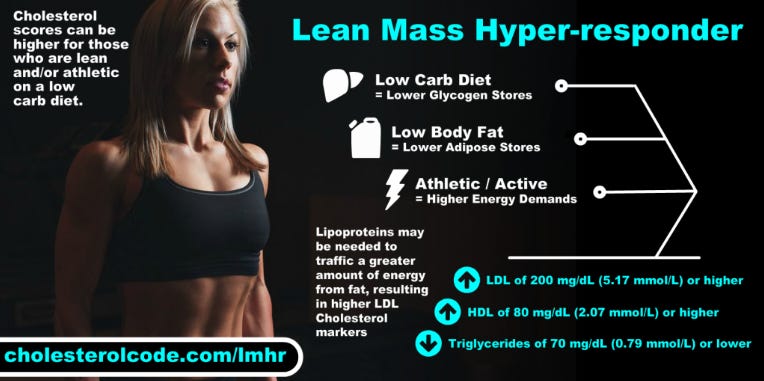
What is a Lean Mass Hyper-Responder?
A lean mass hyper-responder (LMHR) is a distinct blood lipid pattern (phenotype) observed in some individuals who adopt a very low-carbohydrate or ketogenic diet.
This observed pattern is defined by 3 cut points (the “lipid triad”):
LDL cholesterol (LDL-C): > 200 mg/dl
HDL cholesterol (HDL-C): > 80 mg/dl
Triglycerides (TG): <70 mg/dl
While low triglycerides and high HDL-C are generally considered favorable markers of cardiovascular risk, LDL-C levels this high typically raise significant concern for long-term cardiovascular disease risk in mainstream medicine.
Each of these findings can show up on their own but seeing them together is remarkably unusual. When they do cluster like this, it suggests a coordinated metabolic response rather than a set of unrelated anomalies.
Why does this happen?
A possible explanation for this pattern is the Lipid Energy Model (LEM), which focuses on lipoproteins in their role of energy delivery vehicles and how it can potentially explain this pattern.
When carbohydrate intake is very low, the body shifts toward fat as its primary fuel.
The liver responds by transporting more fat through the bloodstream in particles called very-low density lipoproteins (VLDL). This response is often more pronounced in lean individuals, who have less stored fat to draw from directly.
Under the LEM, VLDL particles carry these fats, including triglycerides (TG), to energy-hungry tissues, which take them up rapidly — leaving less TG in circulation (low TG). The VLDL remodel into cholesterol-rich LDL (high LDL-C) as their surface components are transferred to HDL (high HDL-C).
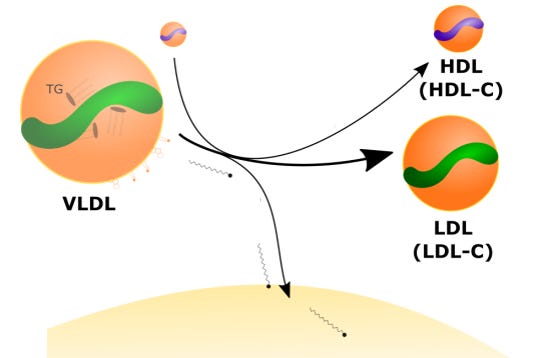
Figure 1: Simplified illustration of lipid energy trafficking, showing fat packaged by the liver into VLDL, delivery of fatty acids (squiggly lines with heads) to energy-demanding tissues, and the remodeling of VLDL into LDL with concurrent transfer of surface components to HDL.
The result is the familiar lipid triad: high LDL-C (and ApoB), high HDL-C, and low triglycerides.12
Why Does This Matter?
LDL-C, or better yet, ApoB is associated with cardiovascular disease and is considered a cornerstone of preventive cardiology.
ApoB (apolipoprotein B) is a protein that sits on the surface of LDL and other cholesterol-carrying particles. Because each particle has one ApoB, measuring ApoB tells us how many particles are circulating in the bloodstream that could deposit cholesterol into the artery wall.
Of note, LDL-C and ApoB typically rise together in LMHRs, meaning that if LDL-C is high, ApoB is usually elevated as well.
However, a given ApoB level does not explain why this level is elevated. In our view, that's the critical question.
Metabolic Dysfunction
In most populations, high ApoB clusters with abdominal obesity, inactivity, insulin resistance, hypertension, high triglycerides, low HDL-C, and small, dense LDL.
In this setting, ApoB may reflect metabolic dysfunction rather than independent risk.3
Genetic Abnormalities
ApoB may be elevated in certain genetic conditions (e.g. Familial Hypercholesterolemia) that alter lipoprotein handling. This may also result in a constellation of other pathological changes including broader disruptions in lipid metabolism, immune function, blood clotting, etc.45
LMHR: A Whole New Context
LMHRs may represent a completely different category: adaptive ApoB elevation, where higher particle numbers are disentangled from insulin resistance, abdominal obesity, physical inactivity, or other lipid disturbances, including genetic abnormalities.
In LMHR, ApoB may be higher due to more fat energy utilization and often tracks with favorable markers such as low TG/HDL-C ratios and lower BMI. Whether cardiovascular risk is equivalent across these different reasons remains an open and important question.
Therapeutic Nutritional Ketosis
This distinction is increasingly important because ketogenic diets are now used for therapeutic purposes beyond weight loss or type 2 diabetes.
Applications for therapeutic nutritional ketosis (not exhaustive):
Bipolar disorder
Depression
Anxiety
Schizophrenia
Parkinson’s disease
Migraine
Inflammatory bowel disease
Disordered eating behaviors
Lipedema
Alzheimer’s disease
Multiple sclerosis (MS)
As these dietary patterns are adopted across a wider range of body types, LDL-C and ApoB elevations, particularly in leaner individuals, may become more common.6
Bottom Line
The emergence of LMHRs reinforces the need to understand the underlying biology to determine what this specific change in LDL-C means for these individuals.
From the desk of Own Your Labs
As a subscriber to TFP_ Newsletter, you can submit questions for upcoming podcast guests, “Ask Me Anything” episodes, general inquiries about the research, and more.